
Book now
Email :
WhatsApp :

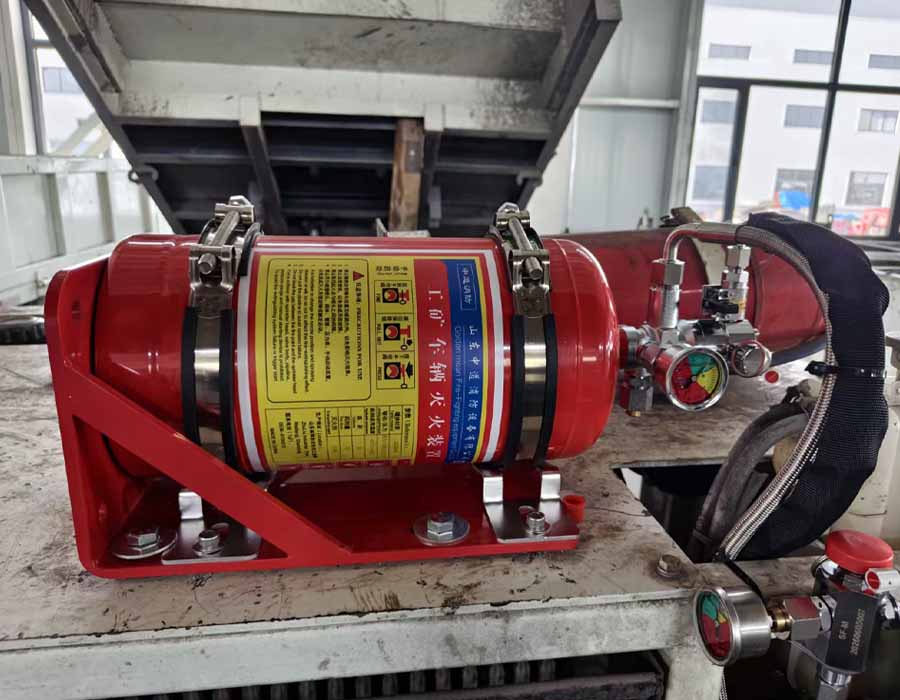
In coal mining operations, mining vehicles (including mine transport trucks, scooptrams, excavators, etc.) become high-fire-risk equipment due to prolonged high-load operation, complex electrical systems, harsh working environments, and other factors. A single mine vehicle fire not only causes millions of yuan in economic losses, but may also trigger secondary disasters, seriously threatening miners’ lives. In response to this challenge, the development and application of the gmfire Vehicle Fire Suppression System is becoming a revolutionary solution for mine safety management.
The hidden fire hazards of mining vehicles are not accidental; their causes have distinct scenario-based characteristics. According to accident data, key areas such as engine compartments, air compressors, and exhaust manifolds are high-incidence fire areas. High-temperature accumulation caused by long-term operation, leakage of hydraulic oil and diesel, aging and short circuits in electrical wiring, plus combustible materials such as coal slime attached to the surface of mining vehicles, together create a “hotbed” for fires. In particular, the operating environments of open-pit and underground mines differ greatly, imposing completely different and stringent requirements on fire suppression system design. A “one-size-fits-all” solution simply cannot adapt to complex working conditions.
Scenario-Based Customized Design: Differentiated Protection Solutions for Open-Pit and Underground Operations
Open-pit mine vehicles are exposed for long periods to high temperatures, strong ultraviolet radiation, and heavy dust. The continuous high temperatures generated by high-load engine operation, once encountering aging and ruptured fuel lines, can easily ignite open flames. At the same time, open-pit operations cover vast areas with scattered vehicles, making real-time full coverage through manual inspections difficult. Delayed fire detection often leads to rapid fire spread. To address this pain point, the Vehicle Fire Suppression System adopts a design approach of “precise detection + efficient coverage.” It is equipped with high-precision temperature sensors that monitor temperature changes at key locations 24/7. Once an abnormal temperature is detected, it immediately triggers audible and visual alarms, buying time for initial response.
On the fire-extinguishing execution side, the system is equipped with customized mist nozzles and multi-angle spray devices. Combined with directional piping layout, it ensures that for the compartment structures of large equipment such as open-pit mining dump trucks, the extinguishing agent evenly covers core areas such as the engine compartment and fuel tank, quickly suppressing initial fires. At the same time, the equipment housing is made of shock-resistant and corrosion-resistant stainless steel, effectively resisting dust erosion and vibration impacts, making it suitable for the high-intensity operating environment of open-pit mines.
Compared with open-pit scenarios, fire suppression conditions in underground mine tunnels are even harsher. Narrow spaces lead to poor ventilation, and flammable and explosive gases such as gas and coal dust tend to accumulate. Even tiny sparks from mechanical friction of mining vehicles can cause explosion accidents. Moreover, once a fire occurs, rescue is difficult and the consequences are more severe. For this reason, the Vehicle Fire Suppression System not only has dual coal mine safety and mining safety certifications, but also takes “explosion-proof safety + intelligent linkage” as its core design principle. All detectors and fire-extinguishing devices are made of explosion-proof materials and can operate safely and stably in flammable and explosive environments, avoiding safety risks caused by the equipment itself at the source.
Considering the particularity of underground electrical system fires, the system uses perfluorohexanone extinguishing agent with excellent insulating properties. It can quickly extinguish open flames without causing secondary damage to electrical equipment. After extinguishing, it leaves little residue and is easy to clean, meeting underground environmental protection and equipment maintenance needs. More critically, the system has an intelligent linkage function. After a fire is confirmed, it not only automatically starts the fire suppression program, but also synchronously sends precise alarm signals to the mine monitoring center, including information such as fire source location and fire severity level, enabling managers to quickly dispatch rescue forces and minimize the impact of accidents. In response to the limited space of small underground transport vehicles, the system adopts a compact layout, cleverly embedding detectors and nozzles into concealed parts of the vehicle without affecting normal vehicle operation or operating space.
Core Technology Empowerment: Upgrading from “Passive Fire Extinguishing” to “Active Prevention and Control”
The modern Vehicle Fire Suppression System has broken through the functional limitations of traditional fire-extinguishing equipment. With multiple innovative technologies, it has achieved a transformation from “post-incident response” to “pre-incident warning and rapid in-process response.” Among these, the purely mechanical fully automatic operation mode is a major highlight. It does not rely on external power or pressure pipelines, completely eliminating the impact of power failures and abnormal pressure on system operation under extreme working conditions. It ensures that the fire suppression program can still start normally in emergencies such as sudden power outages, with response speed measured in seconds, truly achieving “extinguishing the threat in an instant.”
Intelligent upgrades further give the system risk-prediction capability. Through IoT technology and big data analysis, the system enables remote monitoring and data traceability. Managers in the monitoring center can view the fire protection equipment status of each mining vehicle in real time, including parameters such as detector sensitivity and extinguishing agent reserve. Intelligent algorithms can also analyze equipment operation data to predict fire risk points, carry out maintenance in advance, and eliminate hidden dangers in the bud. Some high-end systems also use multi-sensor fusion technology, integrating multi-dimensional signals such as temperature, smoke, and flame, effectively reducing false alarm rates caused by environmental factors such as dust and humidity, and improving detection accuracy.
From design concept to technological implementation, from open-pit mines to underground tunnels, the Vehicle Fire Suppression System is scenario-oriented and technology-centered, comprehensively solving the pain points and difficulties of mining vehicle fire prevention and control. In an era that emphasizes both energy security and production safety, this system is not only an upgrade of mine firefighting equipment, but also an important component of smart mine safety management systems, building a solid safety foundation for the high-quality development of the coal mining industry.
Contact Us a ReachOut For More lnfo!