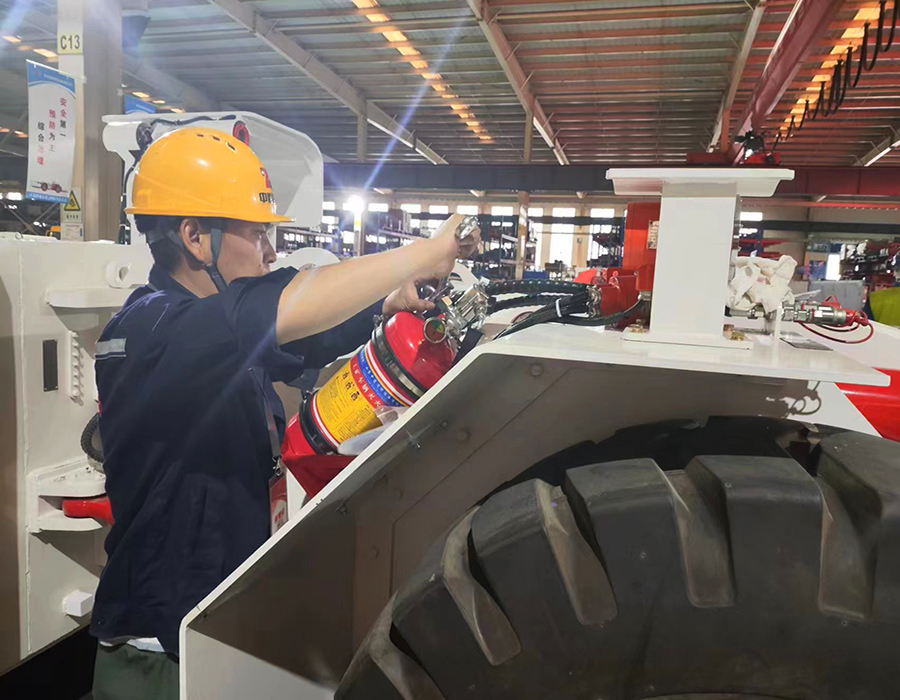
Precise Detection: Capturing Fire Signals in Milliseconds
The core advantage of the underground vehicle automatic fire suppression system lies in its high-precision, multi-dimensional fire detection capability. The system employs distributed point-type thermal detectors, densely deployed in high-risk fire zones such as the engine compartment, fuel tank, electrical control cabinet, and battery compartment to form a gap-free monitoring network. These detectors feature temperature monitoring accuracy of ±0.1°C, enabling real-time capture of minute abnormal temperature fluctuations in the equipment. Even hidden ignition sources concealed within complex structures struggle to evade detection.
These point-type thermal detectors can penetrate deep into equipment interiors. Regardless of how compact the internal space of a mining vehicle is or how complex its piping and wiring structure, they ensure comprehensive protection for all fire-prone areas. Furthermore, the system can flexibly set trigger temperature thresholds based on the specific fire temperature characteristics within the protected space, achieving more accurate fire discrimination. Simultaneously, the system's intelligent algorithms dynamically filter out interference factors like coal dust accumulation and equipment vibration, effectively reducing false alarms. When a detector senses a sustained temperature rise reaching the preset threshold, it immediately transmits data to the intelligent control unit while triggering audible/visual alarms and SMS notifications, alerting both operators and the mine monitoring center, buying precious golden time for subsequent firefighting.
Second-Level Response: Full-Link Coordination to Suppress Flames
Once a fire is confirmed, the system's "second-level" response capability becomes key to curbing its spread. The intelligent control unit completes data processing and fire judgment within milliseconds, simultaneously activating multiple response mechanisms. On one hand, it cuts off the vehicle's power and initiates braking to prevent the fire from intensifying due to electrical faults or continued equipment operation. On the other hand, it automatically activates the fire suppression device, spraying fire suppressant onto the source through high-pressure atomizing nozzles in micron-sized particles. This refined spraying technology increases the contact area between the suppressant and the fire, achieving a dual effect of vaporization cooling and oxygen deprivation/smothering.
The coal mine vehicle automatic fire suppression system features temperature-sensitive self-activation technology, completely eliminating reliance on electrical power and the delays of manual operation, enabling millisecond-level activation under unmanned conditions. The system's agent cylinders are normally in a pressure-less state, housing an advanced mechanical linkage self-activation device. When the detector registers a temperature reaching the fire trigger value, it instantly activates this self-start device, releasing pressure to propel the fire suppression agent rapidly into the pre-set dedicated piping, achieving total-flooding precision suppression. Compared to the minute-long response times typical of traditional manual firefighting, this system requires only seconds from warning to agent discharge, improving response efficiency by over 90% compared to traditional methods. For mining vehicles where fire spread is extremely rapid, this few-second difference is often enough to extinguish the fire in its incipient stage, preventing a small fire from escalating into a major disaster.
Customized Design: Adapting to Diverse Scenario Needs
With the variety of mining vehicle types and significant differences in operational environments, the underground vehicle automatic fire suppression system achieves precise "one-vehicle-one-solution" adaptation through modular design. For equipment with confined spaces underground, such as LHDs and support transport vehicles, the system employs compact discharge devices and customized piping layouts to ensure the suppressant reaches hidden areas like the engine compartment and fuel tank precisely. For instance, an encircling nozzle layout designed for the engine compartment allows all-round coverage of fire-prone components like the engine, belts, and oil pipes.
For large equipment like open-pit mine dump trucks and electric wheel haul trucks, a total-flooding discharge design is adopted, rapidly increasing the suppressant concentration within enclosed spaces to achieve "second-level" smothering suppression. In terms of material selection, the system's core components are made of stainless steel and undergo specialized anti-corrosion and dust-proof treatment, easily withstanding the triple challenge of high humidity, high dust, and high corrosion underground. The piping system utilizes high-strength stainless steel with special anti-corrosion processing, resistant to erosion from corrosive gases and liquids underground, ensuring a long service life.
In summary, with its advantages in precise detection, second-level response, customized design, and intelligent connectivity, the underground vehicle automatic fire suppression system has become an "intelligent guardian" for mine fire safety. As smart mine construction advances, this technology will undoubtedly inject enduring momentum into the high-quality development of the mining industry, enabling the "mobile mine" to truly move away from fire threats and steer towards a safe, green, and sustainable future.