
Book now
Email :
WhatsApp :

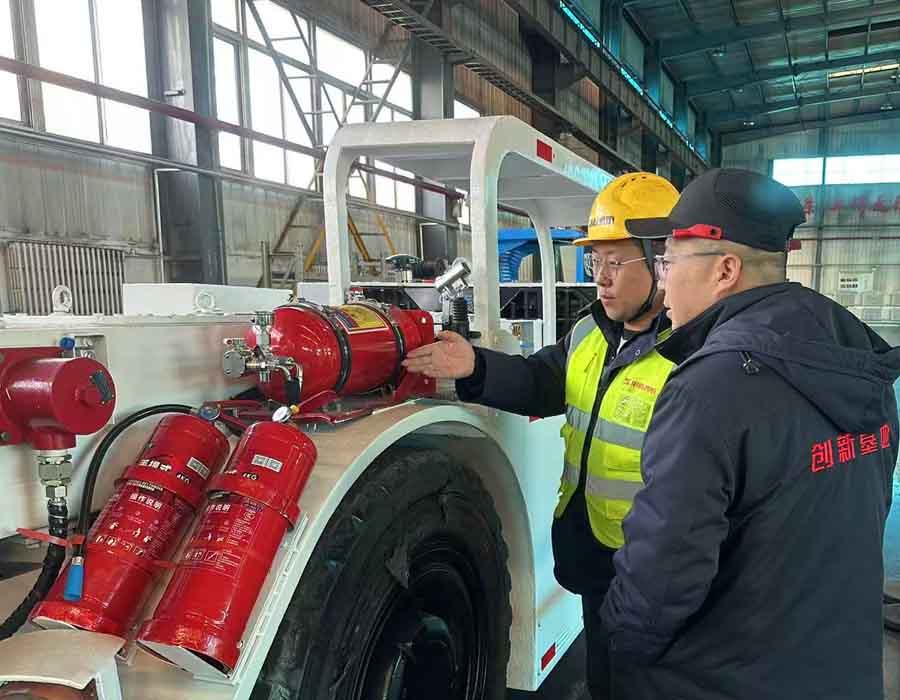
In mining operations, the engine compartment of a mining truck serves as the core power hub, yet it is also a high-risk area for fires. Dense high-temperature components and intertwined fuel and hydraulic lines mean that any leak combined with high heat can trigger a fire. Moreover, harsh environments such as sandstorms and intense sun exposure in open-pit mines, as well as dust and flammable gases in underground roadways, further amplify the risk of fire spread. The vehicle-mounted automatic fire suppression system/device, with its "small size" delivering "big power," meets the protection needs of engine compartments in both open-pit and underground mining trucks through customized design, building the first line of defense for mine safety both in China and around the world.
1. Risk Analysis: Fire Hazards and Protection Pain Points in Mining Truck Engine Compartments
The engine compartment of a mining truck concentrates high-temperature components (exhaust manifold 500–700°C, turbocharger over 600°C), fuel lines, and electrical wiring, creating a significant fire risk. Open-pit mining trucks operate under heavy load in high-temperature, dusty conditions, with fuel leakage being the primary cause (over 60% of incidents). Wind can rapidly spread flames, and manual inspections often fail to provide timely warnings. Underground mining trucks face additional challenges: confined spaces, presence of explosive gases like methane, power outages, and dust interference. These require systems with high explosion-proof ratings, power-failure tolerance, and stable detection sensitivity to prevent both ignition and false/missed alarms.
2. Core Logic: The Customized Protection Principle of Automatic Fire Suppression Systems
An automatic fire suppression system is not a standardized product; instead, it is built around three core principles—"scene adaptation, precise prevention, and efficient response." Through full-process customized design (detection → linkage → discharge), it achieves targeted protection of the engine compartment. The core logic can be summarized as "3D customization + dual safeguards."
2.1 3D Customization: Core Design Tailored to Open-Pit/Underground Scenarios
Detection System Customization:
For open-pit mining trucks, an "electronic intelligent prevention and control network" is used. Highly sensitive infrared flame detectors and heat-sensing cables are installed to monitor temperature changes 24/7 and provide real-time alerts when anomalies occur. For underground mining trucks, a "passive mechanical detection" system is adopted. Heat-sensitive detection tubes are laid directly above high-temperature components, requiring no electrical power. When the temperature rapidly rises to a preset threshold, the system automatically triggers the linkage, avoiding electrical sparks that could ignite gas explosions. For both types, detectors are precisely positioned over key high-temperature zones (exhaust manifold, turbocharger, etc.) to form a multi-point monitoring network, ensuring early fire detection.
Extinguishing Agent Customization:
Selection differs based on fire type. For open-pit truck engine compartments, where fuel fires dominate, water-based agents or ultra-fine dry powder are chosen. Water-based agents extinguish fires by interrupting the free radical chain reaction and also provide sustained cooling to prevent re-ignition, achieving over 90% efficiency. For underground mining trucks, where electrical safety and explosion protection are critical, perfluorohexanone is preferred. It has excellent dielectric properties, leaves no residue after discharge, does not damage sensitive electrical equipment, meets environmental requirements, and is suitable for dusty, gaseous underground environments.
Discharge System Customization:
The layout is optimized according to compartment structure. Open-pit truck engine compartments are relatively large, so a combination of "top-mounted total flooding + directional spraying" is used. Atomizing nozzles are aimed at risk points such as the turbocharger and fuel lines to ensure even coverage. Underground truck compartments are narrow, so "embedded distributed nozzles" are employed. Nozzle spacing is reduced, and nozzles are embedded in component gaps to achieve gap-free coverage. All discharge components are made of explosion-proof stainless steel, resistant to dust and corrosion, preventing clogging and failure.
2.2 Dual Safeguards: Key Design Features Enhancing Protection Reliability
Dual Activation Modes: "Automatic + Manual" activation. In automatic mode, open-pit trucks use real-time temperature detection to trigger the system, while simultaneously cutting off the fuel pump and electrical circuits to stop fire spread. Underground trucks use mechanical activation without manual intervention, but are also equipped with manual emergency buttons for driver intervention.
Dual Environmental Adaptability:
For open-pit trucks, the system must meet IP67 ingress protection, resist vibration, withstand high temperatures and sun exposure, and handle rough terrain. Backup batteries ensure continuous operation after power failure. For underground mining trucks, the system strictly complies with explosion-proof standards. The housing is made of explosion-proof materials, wiring uses flame-retardant and explosion-proof cables, and the design adapts to damp, gaseous environments. Dust filters prevent particles from entering detectors and affecting sensitivity.
3. Value Highlighted: Core Advantages of the Customized Automatic Fire Suppression System
Second-Level Response, Suppressing Incipient Fires:
From detection to agent discharge takes only seconds, effectively extinguishing fires before they can spread, preventing small fires from escalating into major incidents and minimizing losses.
Non-Damaging Protection, Adapting to Diverse Scenarios:
Perfluorohexanone does not damage electrical equipment; water-based agents do not contaminate engine compartment components. The customized design does not interfere with normal truck operation or heat dissipation, adapting to both open-pit and underground environments.
Cost Reduction and Operational Efficiency Improvement:
Prevents truck downtime and repair/replacement costs caused by fires, reducing mine shutdown losses. Automated protection replaces manual inspections, lowering labor costs while extending the service life of engine compartment components and improving truck operational efficiency.
Compliance and Environmental Friendliness, Meeting Industry Standards:
Both perfluorohexanone and water-based agents meet environmental requirements, have zero ozone depletion potential, and support low-carbon mine development. Underground systems meet explosion-proof safety standards; open-pit systems comply with heavy equipment safety regulations—helping mining enterprises operate in compliance.
4. Conclusion
Fire prevention and control in mining truck engine compartments is a critical link in mine safety production. The automatic fire suppression device, with its "small size," carries the heavy responsibility of safety. Through customized design tailored to open-pit and underground scenarios, it effectively solves core pain points such as environmental adaptation, risk prevention, and response efficiency, achieving "big protection with a small footprint." In the future, as smart mine construction advances, automatic fire suppression systems can integrate IoT and big data technologies to enable remote monitoring, intelligent early warning, and precise intervention, injecting even greater power into mine safety production—truly achieving "small protection, big energy guarding."
Contact Us a ReachOut For More lnfo!